
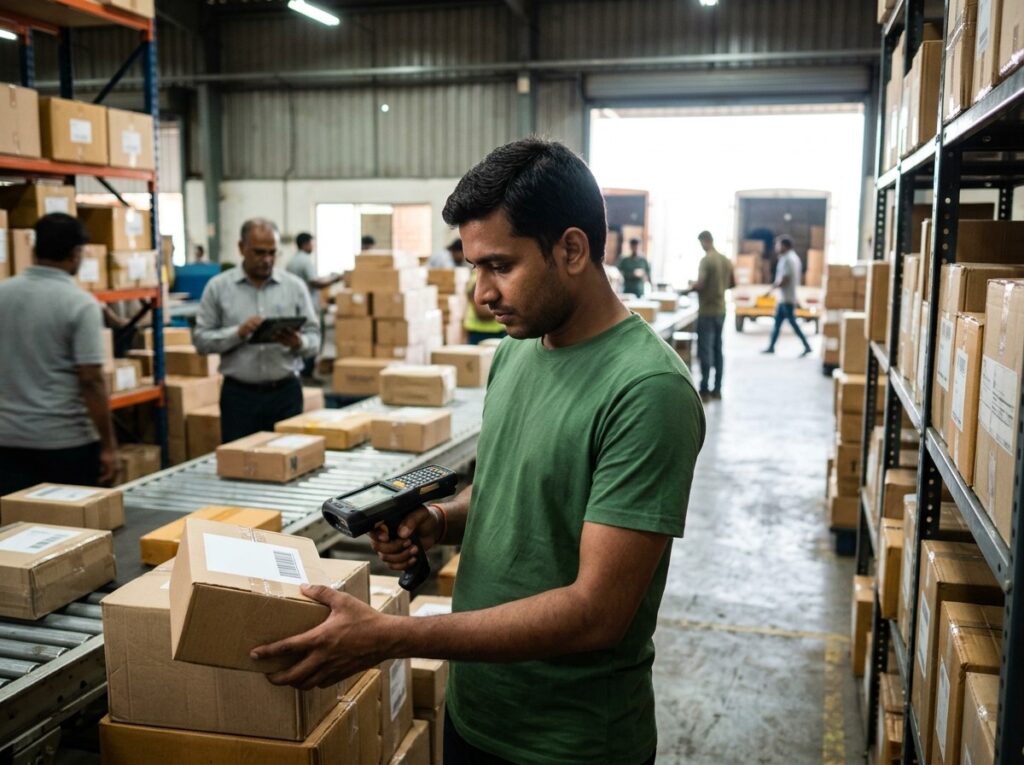
Courier, parcel and last-mile delivery businesses run on speed and accuracy. Every consignment moves through booking, pickup, manifest, hub, delivery and billing, and each step creates data. Without the right software, that data lives in spreadsheets, paper runsheets and chat messages, and customers keep calling to ask “Where is my parcel?”
Whether you run a same-day courier in Chicago, a regional parcel network in the north of England, a freight forwarder in Rotterdam, a last-mile operator in Auckland or a messaging company in Mexico City, the requirements are remarkably similar. Here is a checklist of twelve features to look for, based on our experience building courier management software that runs daily operations at 6+ courier companies in India, including international shipments.
Booking and operations
1. Fast consignment booking with automatic tracking numbers
Saved customers and addresses, postcode or ZIP lookup, and automatic rate calculation turn booking into a matter of seconds. The system should generate waybill or tracking numbers in your own format and print labels with barcodes straight away.
2. Flexible rate cards
Zone-based, weight-band and customer-specific rates, with volumetric weight, fuel surcharges, remote-area fees and special handling charges applied automatically. Sales staff should be able to quote accurately without calling the office.
3. Pickup management
Record pickup requests from the web, phone or customer portal, assign them to drivers by area, and confirm completion from a mobile app so the office always knows what has been collected.
4. Manifests and hub operations
Outbound and inbound manifests, bagging, and hub-to-hub transfers with barcode scanning at every handover. Scan-based updates keep tracking accurate and make missing items easy to trace.
5. Delivery runsheets
Assign deliveries to drivers or routes, then record delivered, failed attempt and return-to-sender status with standard reasons. Drivers should update status on their phones rather than bringing paper back at the end of the day.
6. Electronic proof of delivery
Receiver name, signature, photos and a timestamp captured on the driver’s phone, and ideally location too. Electronic POD settles disputes quickly and is often a requirement for business customers.
Customers and tracking
7. Online tracking for your customers
A tracking page on your own website where customers enter their tracking number and see every scan event. This alone cuts down “where is my parcel” calls dramatically, and it keeps your brand in front of the customer rather than a third-party platform.
8. Customer and corporate account logins
Let business customers book shipments, upload bulk orders, download reports and view invoices themselves. For e-commerce clients, an API or file import saves hours of manual booking.
9. Automatic notifications
SMS, email or WhatsApp updates at booking, dispatch, out-for-delivery and delivery. Proactive messages reduce failed deliveries and improve the recipient’s experience.
Billing and control
10. Billing and accounts
Invoices, credit notes, receipts and outstanding balance reports, with VAT or sales tax handled correctly for your country, and exports for your accounting package.
11. Franchise and branch management
Separate logins, commission rules and settlement statements for each franchise, agent or branch, so growth through partners does not turn into a reconciliation headache.
12. International shipments
Handle international consignments, partner carriers and customs documentation in the same system as domestic operations, instead of running a separate spreadsheet for exports.
Questions to ask before you buy
- Is it cloud-based, so every branch, hub and driver can use it from anywhere?
- Can it be configured with my company name, tracking number format and rate structure?
- Who hosts it, where is the data stored, and how are backups handled?
- Does it support my privacy obligations, such as GDPR in Europe and the UK, for recipient names, addresses and phone numbers?
- Can you migrate my existing customer and rate data?
- What support and training are included, and in which time zone?
- Can new features be added for my specific workflow?
Ready-made or custom?
A proven product configured for your business gets you running quickly at a lower cost than building from scratch. The best option is software that is ready to use but still customisable, so you are not forced to change how your operations work. If you are still juggling spreadsheets for bookings and billing, see our guide to the signs you have outgrown Excel.
A courier platform also works best alongside a good website and driver app. We build courier websites with tracking pages and mobile apps for drivers; read more about websites for courier companies.
Why courier companies choose Vimansoft
- Proven in daily operations: our courier management software runs at 6+ courier companies in India, covering domestic and international shipments.
- Configured to your business: your brand, tracking format, rate cards and workflows, with custom features where you need them.
- Fixed scope and fixed price agreed up front, with video calls on Zoom, Google Meet or Microsoft Teams at times that suit your time zone.
- One partner for software, driver and customer apps, websites, hosting and support, since 2009.
See how our courier software fits your operation
Vimansoft Technologies has helped 200+ businesses since 2009 with websites, custom software, mobile apps and digital marketing. Tell us what you need and get a free, no-obligation plan and quote.

Vimansoft Technologies designs websites and builds custom software, mobile apps and digital marketing campaigns for startups and SMEs in the Americas, the UK, Europe, Australia and New Zealand. We have helped 200+ businesses since 2009.